SocialMinds at RSE'26: presenting the SocialMinds cognitive architecture
This week, the lab participated in Robotics and Software Engineering 2026 (RSE'26), held this year at IRI (CSIC-UPC) in Barcelona.
Séverin Lemaignan presented the lab’s work on building a LLM-centric architecture for autonomous social robots:
“The LLM Proposes, the Robot Disposes: An Open Neuro-Symbolic ROS 2 Architecture for Social Robots”
You can download the slidedeck here
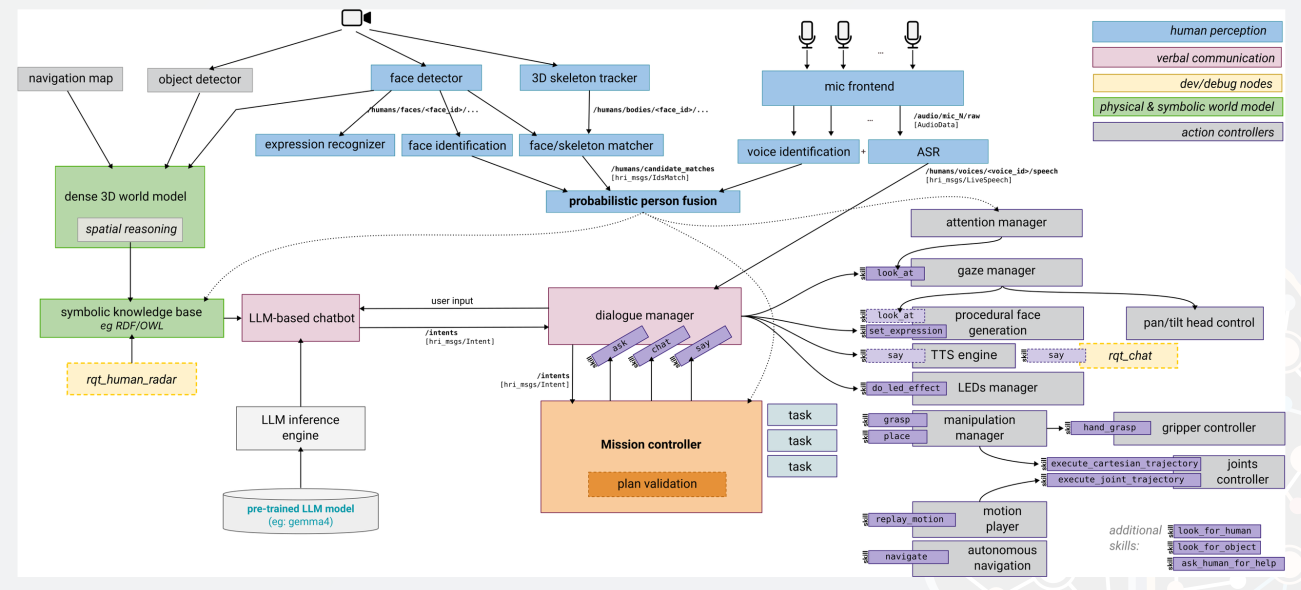
The talk presented the SocialMinds cognitive architecture, the lab’s open-source answer to a question end-to-end approaches like Vision-Language-Action (VLA) leave open: how do we build social robots that share spaces with humans over long periods, while staying auditable and explainable? Instead of keeping all knowledge implicit in the model’s weights, SocialMinds positions the LLM as one component within a modular, neuro-symbolic pipeline organised around an explicit, queryable world model.
The talk highlighted three design points:
- Grounding through a shared symbolic layer. The robot’s 3D perception is made available to the LLM via ROS4HRI (REP-155) social perception, the reMap voxel-based spatial representation, and the KnowledgeCore RDF/OWL knowledge base, so every subsystem works from the same queryable world model.
- An explicit locus of control. Every request (spoken, on the touchscreen, remote, or self-generated) is routed through a single intent message, and a mission controller validates the proposed plan against the current world state before any skill is dispatched. The LLM proposes; the controller disposes.
- Inspectable intermediate representations. Knowledge-base contents, assembled prompts, emitted intents and validated plans are all logged and visualisable, supporting explanation, audit and regulatory compliance.
The architecture is ROS 2 native, modular and open source, with the LLM as a replaceable component; its packages are on the lab software page. The work is funded under the EU CoreSense and ARISE projects, together with the SAFELY and DIEGO grants.