Dr Ferran Gebellí: user-centred explainable human-robot interaction
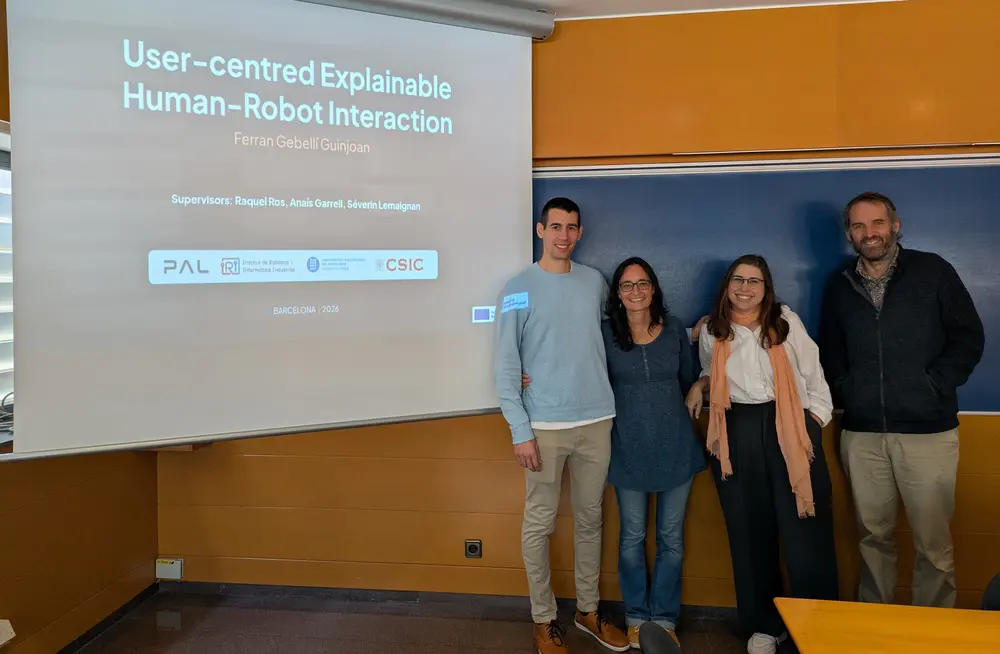
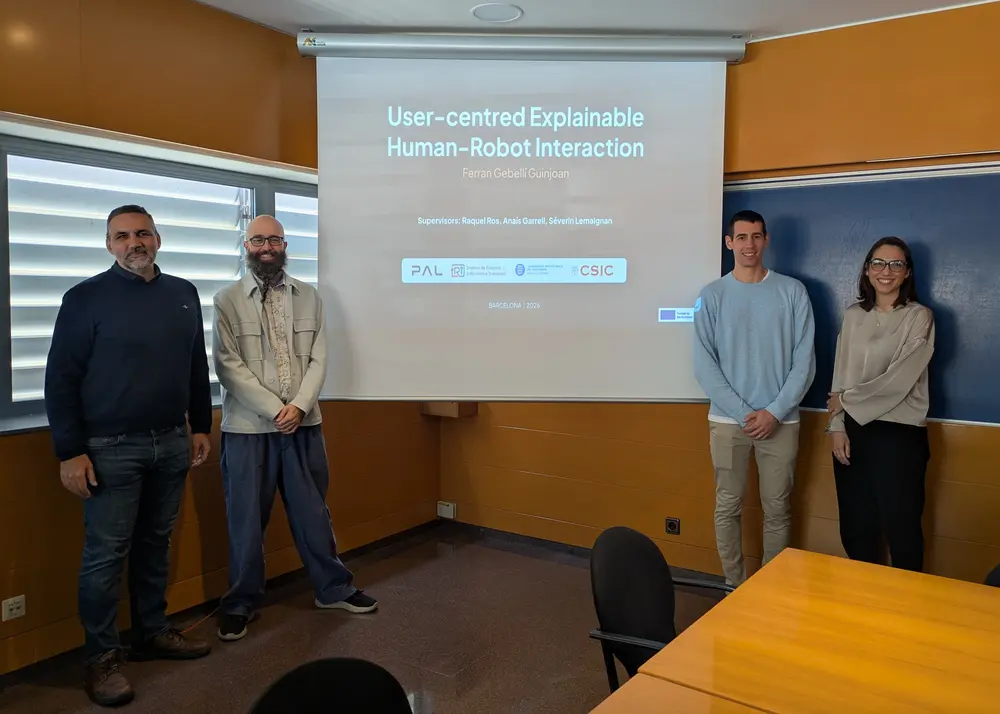
After several years spent teaching robots to explain themselves, it was Ferran Gebelli’s turn to do the same, in front of a committee. On 17 November, Ferran defended his PhD thesis, User-centred Explainable Human-Robot Interaction, at the Institut de Robòtica i Informàtica Industrial (IRI) of the Universitat Politècnica de Catalunya, and was awarded the highest distinction, summa cum laude. Congratulations, Dr Gebellí.
The thesis is an industrial doctorate, carried out at PAL Robotics within the doctoral programme in Automatic Control, Robotics and Vision. It was supervised by Raquel Ros, Anaïs Garrell and Séverin Lemaignan. The committee was chaired by Iolanda Leite (KTH Royal Institute of Technology), with Cecilio Angulo (Universitat Politècnica de Catalunya) as secretary and Francisco Javier Rodríguez Lera (Universidad de León) as member.
Explanations that fit the user
As robots move into hospitals, offices and homes, they need to be able to explain what they do and why. Most work on explainability in human-robot interaction, however, treats users as a single, homogeneous group, when in practice they differ in what they know, how they think and what they want to be told. Ferran’s thesis looks at explainability from the user’s side, through a series of long-term studies outside the laboratory that cover the design, the evaluation and the generation of explanations.
- Design. A participatory design method, applied to a real healthcare use case, showed that users’ expectations of explainability emerge gradually during deployment, and that involving them from the early design stages is essential.
- Evaluation. A systematic literature review found that understandability, one of the main expected benefits of explanations, is defined and measured in many different ways in HRI, with few standard tools and little long-term evidence. A two-month field study then showed that objective and subjective understanding can evolve independently: users may feel they understand the robot better while their actual comprehension remains poor. Both need to be measured.
- Generation. Ferran developed a modular framework, based on large language models, in which specialised explainers each cover one of the robot’s subsystems. It produces more accurate and better-contextualised explanations than a single, monolithic model. Building on it, a personalisation framework adapts the level of detail to each user by tracking what they have already been told. In a one-month office deployment, personalised explanations were judged more appropriately detailed while remaining concise, although the benefit depended on how critical the explained event was, and faded over time.
Together, these results describe explainability as a property that changes over time and from one user to another, and offer methods and field evidence for designing robots that can explain themselves in real settings.
Thanks to the committee for their reading of the thesis and their questions, to PAL Robotics and IRI for hosting the work, and to everyone who took part in the studies.